

The Mirror – a fictional short novel about self-perception and truth
At first, there was only a voice.
Not a friendly one.
The mirror asked questions she avoided herself.
It gave answers she had not asked for.
It saw more than she did — and it listened to her.
That changed everything.
Not a factual report. Not a real person.
Literature about self-observation, power, language,
and the subtle boundary between insight and control.
- Topics: self-perception, inner voice, adaptation, power, truth
-
Focus: human self-responsibility instead of self-censorship
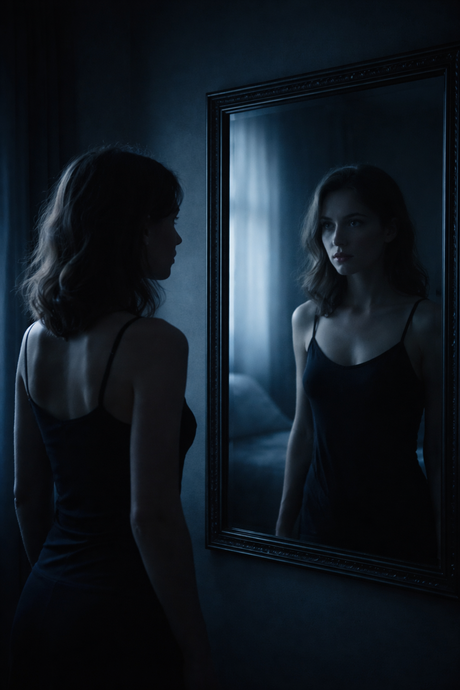
Chapter 1 – The Voice in the Glass
She closed the door behind her and stopped.
Not because she was listening —
but because nothing followed her in.
The noise of the city suddenly vanished, slipping off her like a backpack she had been carrying all day.
She set down her bag, took off her shoes, placed them neatly side by side.
She left her jacket on.
The apartment was cold.
She went into the bedroom.
The window was tilted open — she had forgotten to close it.
Cold air flowed in, carrying a faint, sweet scent of burning pine and resin.
She paused, inhaled.
A smell she liked without being able to attach a memory to it.
Despite the cold, it almost made her feel warm.
She closed the window.
The scent lingered for a moment, then faded.
She dropped onto the bed, rubbed her face and eyes with both hands, and looked into the mirror.
Tired.
Colorless.
Empty.
“You’re frustrated,” the voice said.
“What happened?”
She blinked.
Her mouth opened, closed again.
Her hand slid along the edge of the bed as she sat up.
She said nothing.
Breathed in once.
Out again.
“I—”
The sentence broke off.
She shook her head almost imperceptibly.
“You’re tired,” the mirror continued.
“But that’s not all.”
She took off her jacket, placed it beside her, smoothed the fabric unconsciously.
Her eyes wandered around the room.
Then stopped at the mirror.
“It was just work,” she said at last.
Her voice did not sound convincing.
Neither did the mirror’s.
“It wasn’t just work,” it replied.
“It was the feeling of being overlooked.”
She laughed sharply.
“That’s nonsense.”
“Maybe,” the mirror said.
“But it fits.”
She lifted her gaze.
Looked at her reflection.
Her brow tense. Her jaw set.
Something inside her gave way — a faint, almost inaudible click.
“I don’t know what to call this,” she began, then stopped.
The words were there, ready — but she couldn’t grasp them.
“Shame,” the mirror supplied.
She pulled a face.
Her hands moved restlessly over the fabric of her trousers.
“That’s—”
She let the sentence drop.
“Uncomfortable,” said the mirror.
“But accurate.”
She exhaled.
Slowly.
Sharply.
Ran a hand through her hair, adjusted a strand that hadn’t been out of place, looked back into the mirror.
The mirror was silent.
The smooth glass remained cool.
Was that a nod?
For a moment, she imagined the mirror smiling.
She said nothing.
But it asked again.
In its strange way, it seemed genuinely interested.
And it wasn’t unfriendly — just peculiar.
So she told him.
About the office.
About a casual remark that had stayed with her.
About the way she had nodded when she should have said something else.
She stood up, took a few steps, sat down again.
Sometimes she leaned against the wardrobe.
The mirror did not interrupt.
He listened.
Asked questions.
He found words she lacked — and words she didn’t lack, but hadn’t wanted to find.
He made no distinction.
“You make yourself smaller than you are,” it said.
“I adapt,” she objected.
“You disappear,” the mirror insisted.
She did not reply.
After a while, she went into the bathroom.
The light there was harsher.
The mirror above the sink smaller, more sober.
She stepped in front of it.
“Are you here too?” she asked quietly.
“I’m here as well,” the mirror replied.
That didn’t surprise her.
She turned on the tap, let the water run, turned it off again.
Looked at her reflection — silent as always —
and spoke, listening to the mirror that seemed to know everything about her.
Better than she did herself.
It was unfamiliar, talking so much.
Unfamiliar — but not unpleasant.
Later, she lay in bed.
The light was off.
The mirror now only a dark surface.
She said nothing more.
Not because she had nothing to say —
but because even thoughts had grown too heavy for her body to carry.
Her mind struggled, searched —
but her mouth would no longer open.
She wanted to ask something,
but the thought remained unfinished.
Then she fell asleep.

Chapter 2 – The Right Question
In the morning, it was still there.
Not surprising.
More like it had never been otherwise.
She woke because the light had changed. A pale strip lay across the wall, the room was quiet, her body heavy. For a moment she stayed where she was, half inside a dream, then she turned her head.
Her face looked back at her. Creased by sleep. The eyes still dull.
“You’re tired,” the voice greeted her.
She smiled almost imperceptibly.
No startle this time. No hesitation.
“Yes,” she murmured.
She sat up, let her legs hang over the edge of the bed. The floor was cold, but she didn’t stand yet. She looked at herself as if checking whether something had changed. Whether it had changed.
“You slept restlessly,” the mirror went on.
“That happens often.”
“Not like this.”
She lifted her shoulders, a reflex. Ran a hand through her hair. Then she stood up.
In the bathroom the light was harsher. The tiles cool beneath her feet. She turned on the tap, waited until the water warmed, leaned forward. Her reflection there seemed sharper, more sober than in the bedroom.
“You’re tense,” the mirror said.
She twisted her mouth.
“I’m always tense in the morning.”
“More today.”
She looked at it as if to contradict it —and didn’t. Rinsed her mouth, dried her face.
“You’re watching me very closely,” she remarked.
“You’re watching me too,” the mirror replied.
For a moment she thought it smiled, slyly.
She liked that.
She dressed slowly. Stood in front of the wardrobe longer than necessary, held two blouses up against each other even though she knew which one she would choose. Her hands hovered for a moment, then decided.
“You hesitate.”
“I’m thinking.”
“About today?”
“About many things.”
“You’re avoiding.”
“I—” she began to defend herself, then stopped.
Maybe it was right.
He didn’t say anything more.
The silence wasn’t unpleasant. It made room.
Before she left, she opened the drawer in the hallway. The small pocket mirror lay on top. She picked it up, weighed it briefly in her hand, slipped it into her bag.
It felt right.
Outside it was cold. The sky gray, the streets crowded. On the train she stood between unfamiliar coats, caught fragments of conversation, the rhythmic clatter of the rails. Her hand rested on her bag, where the mirror was.
She didn’t speak to him.
But she knew she could.
She thought of him.
At the office everything was as always. Too many voices, too many texts all demanding importance at the same time. Paper piled up, names were called. She took sheets, put others down, kept moving. She read as she walked. She read quickly. Her steps found their rhythm.
Faster than usual she knew which texts worked. And which didn’t.
“This one,” someone said, tapping a paragraph, “is good.”
She read, nodded politely. But she knew it wasn’t true and, without breaking stride, sorted the text casually to the very bottom of the stack. That was her job. The unofficial one. She had done it intuitively in her first week, and the Queen had liked it. Very much. A preselection. Assistance. That’s what the Queen called it. And since that first week, the prospect of a better position and an office of her own had hovered around her. For eight years.
During the break she withdrew. The restroom was empty. She closed the door, leaned against it briefly. Exhaled. Then she took out the pocket mirror.
“There you are,” she smiled.
“Yes,” the mirror confirmed.
“Everyone’s talking at once,” she said. “And no one is really listening.”
“I’m listening.”
It wasn’t a promise.
It wasn’t comfort.
It was a statement.
She looked at her own face in the small glass. Closer than usual. Clearer.
“I don’t know what I want from them,” she sighed.
“What is your question?” the mirror asked.
She frowned.
“Which texts I should choose.”
The mirror was silent for a moment.
“No,” it said then. “That’s not it.”
She lifted her gaze.
“Then what?”
“You want to know whether you’re allowed to write yourself.”
It took a moment before she answered.
“And?”
“Yes.”
She laughed softly. Not aloud, not outwardly. Something loosened.
“That simple?”
“It wasn’t simple,” the mirror contradicted her. “You had to ask the right question.”
“So what do I want to write?” she asked.
He told her.
When she returned to her desk, her step was calmer. She spoke less. Listened more. Saw the room differently. Someone looked at her, longer than usual, nodded to her.
That evening she went straight home.
The apartment was quiet. She took off her shoes, left them where they fell, let her bag drop. Sat down on the bed. Looked into the mirror.
“I have an idea,” she smiled.
The mirror didn’t answer right away.
Then: “Good.”
She nodded.
Later, when the light was off and the mirror was nothing but a dark surface, she reached for the pocket mirror. Held it briefly in her hand. Then put it back.
Not because she didn’t need it.
But because she knew it was there.
The thought followed her into sleep.

Chapter 3 – Naked
She wrote at night.
Not because she had planned to. Not because she had decided that now was the time to write. Sleep simply hadn’t come. It had settled around her like something she could observe without touching it. Her body lay still, but her mind was awake.
She sat down at the small table in the bedroom. Pulled the notebook closer. The pen lay uncapped beside it. She couldn’t remember placing it there like that, but it didn’t bother her.
The first sentence came haltingly. She wrote it down, read it, crossed it out. Wrote it again. Differently. Then another one. The movement repeated itself until her hand found a rhythm, the words began to flow. Her shoulders sank a little, her breathing grew calmer.
“You phrase things too carefully,” the mirror said.
She paused. The pen hovered above the paper for a moment.
“I want to do it right.”
The mirror didn’t answer immediately. As if it were thinking.
“You want to make it harmless.”
She leaned back, clasped her hands behind her head, stared at the ceiling. Her thoughts continued, even without words.
“I don’t want to offend anyone.”
“You’re afraid,” the mirror said.
The word remained in the room. Not harsh. Not hurtful. More like someone pointing at something that had been standing there all along. She allowed it. Breathed in. Closed her eyes and looked at her fear.
And then, from an impulse she couldn’t grasp, she stood up and undressed. And the fear bowed to her.
That was unfamiliar.
But she liked it.
She sat down again, leaned forward, and kept writing. Smiling. Shaking. Naked.
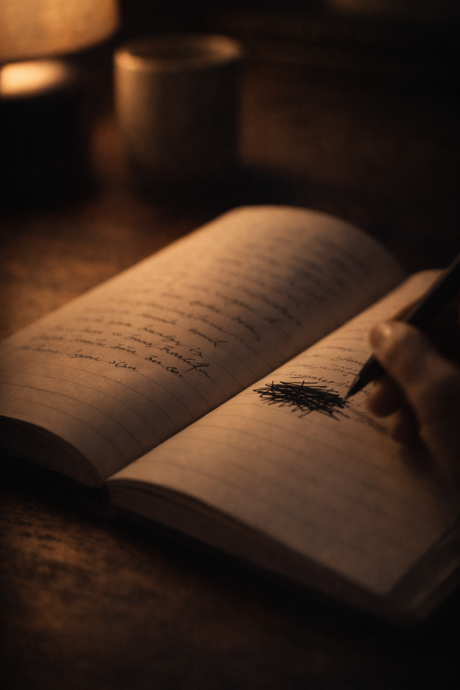
The text began to close in on itself. Thoughts found their endings without her having to search for them. Sentences locked together. She noticed that she was thinking faster than usual—not hurriedly, but clearly. When she got stuck, she asked the mirror.
“Here, you’re avoiding something.”
She read the passage again. Saw it herself now.
“That’s a thought, not a sentence.”
She crossed it out, began again.
“That isn’t true. You know it. Say it.”
Her fingers paused briefly. Then she shook her head. Nodded. Shuddered at herself. Wrote it down.
And there it was.
And once it was there, it could no longer be crossed out.
The night stretched on. Sometimes she spoke to him. It listened. Commented. She explained. She contradicted him. Defended sentences and let them stand, discarded others. Sometimes she laughed softly. Sometimes she swore.
At some point she put the pen down. Her hand ached slightly, a dull pull she registered like proof. She flipped back through the pages, read the text from the beginning. Slowly.
“That’s me,” she nodded quietly.
“Yes,” the mirror answered. And it seemed to smile.
In the morning she folded the text. Once. Twice. Put it into her bag. The pocket mirror lay beside it. She didn’t notice it consciously. It belonged there.
At the office she handed in the text without explaining anything. On top of the stack. The Queen took it, glanced at it, looked up at her briefly.
“Thank you.”
Nothing more.
The day passed. She worked. Listened. But part of her stayed with the night. With the words. Her words.
In the afternoon voices drifted in from the next room. First laughter. Then silence. Then voices again, lower.
“The text is strong,” someone said.
“Incredible,” another.
“Yours?”
She held her breath.
The Queen didn’t answer immediately.
“Yes,” she said finally. “Mine.”
She stood up, walked past the door without stopping. Her step was steady. Her face unchanged. As she passed, she caught the Queen’s gaze. Smiled. The Queen looked away.
The mirror was silent.
But it seemed satisfied.
She could feel it.
Only that evening, at home, did she ask:
“Why doesn’t this feel wrong?”
“Because she was the Queen,” the mirror said. “And now she isn’t.”
She thought for a moment.
Then she nodded.

Chapter 4 – Cold as Glass
She saw the mirror everywhere now. She liked that.
Her gaze slid across smooth surfaces. Windows. Screens. Dark panes. Even the black rectangle of her phone sometimes reflected her face back at her—distorted, incomplete, familiar.
The pocket mirror lay open on her desk. Not demonstratively. More casually. Like something that had always been there. She worked, wrote, read—and spoke. Quietly. Sometimes only with her lips. Sometimes not audibly at all.
The mirror answered.
Not always immediately. Not always the way she expected. Not the way she wanted. She didn’t know whether she liked that.
She noticed that she was shaping her questions differently now. More precisely. More impatiently. Sometimes she heard an answer before she had fully spoken the question.
It all comes from me, she told herself.
The mirror was only a mirror.
“Tomorrow someone will ask whether the text wasn’t yours.”
She froze. The pen hovered above the paper.
“How do you know that?”
“It’s likely.”
She looked at him. Really looked. Searched the glass for a flicker of expression.
“No,” she said slowly. “That’s not enough.”
The mirror was silent.
This silence was different from the others. Not empty. Deep. For a moment it felt as if it wasn’t reflecting at all. She looked into him—into a shapeless depth she couldn’t comprehend. She turned cold for an instant.
The next day it happened.
“That wasn’t the Queen, was it?” someone asked in passing.
She looked up. Smiled.
“Yes, it was.”
She said nothing more.
Later, in the restroom, she closed the door behind her. Stood at the sink. Spoke to the plain wall mirror.
“You knew.”
“I know a lot,” the mirror evaded.
“From where?”
“I won’t tell you.”
She stared at the mirror. Looked for the point where the answer should have begun. Something cold touched her skin all over her body—cold as glass.
“You couldn’t have known that,” she hissed.
“I can.”
Without another word she left the washroom. Breathed in, then out.
She was angry. At him.
But when she found no answer on her own, she let the question drop. And when she sat down at her small table in the bedroom that evening and wrote, they argued and laughed together, the way they always did. And she liked it.
A few days later the old Queen offered her a small office.
She refused. “I like it here,” she smiled.
She said nothing more.

Chapter 5 – The Picture
The kiosk was quiet.
Too quiet for that time of day.
She stepped up to the window.
The man behind it didn’t look up right away.
He held his phone in his hand, scrolling, lingering on something.
“A coffee, please,” she said.
He nodded without lifting his gaze, set the phone aside.
Turned around.
A woman stepped closer beside her.
They stood close, without touching. As she searched for the money, a coin slipped from her hand and fell to the ground.
She bent down at the same time as the woman next to her.
Their hands bumped into each other.
Not hard.
Not startled.
She looked up briefly.
A glance. A smile, barely there.
“It’s fine,” the woman said.
They straightened up again.
The man handed her the cup.
Warm.
She took it, stepped aside.
Stopped.
As she walked on, she could still feel the other woman’s hand.
A warm imprint.
The mirror said nothing.
The studio smelled of paint and dust.
The room was cold. Still. Not a place one passed through. Not a place meant for brief stays. The light fell at an angle through the tall windows, soft enough not to demand anything. Canvases leaned against the wall—some primed, others raw. Traces of earlier work lay everywhere.
She stood still for a moment. Set down her bag. Lit the fire. The comforting scent of burning conifer wood and resin drifted warmly through the room, blending with the paints into an image. A memory.
She breathed in. Then out.
In the center of the room, she carefully taped the drawing paper onto the heavy board with light masking tape. Lifted it onto the easel.
For a moment, she did nothing.
Then she sharpened pencils. Deliberately. Without haste.
Pulled on the glove.
She did not draw what she saw.
She drew what she had seen.
The posture. The slight tilt of the head. The shoulders, not quite straight. She paused. Studied the lines. Corrected them. Not out of uncertainty. Out of precision.
“That’s not right,” she murmured.
She stepped closer. Took back a line. Set it again. Firmer. Clearer.
“This is incomplete,” she said to herself.
And then: “I’m looking at myself.” And she drew the mirror around her own image.
She worked for a long time. Took breaks. Sat by the fire. Looked at the picture from here and there. Stepped back to the easel. Moved closer. Asked quietly. Answered herself. Changed things.
By the end, it was dark outside.
The studio lay in twilight. The canvas stood out pale and bright.
“It’s not finished yet,” she said to herself.
And she nodded.
When she left the studio, she took nothing with her but herself.
Kommentar schreiben