

Power Outage Berlin – A Literary Narrative about AI & Responsibility
“The Score” is a fictional short novel about the consequences of a large-scale power outage in Berlin and about how AI-assisted investigations can falsely cast suspicion on people.
Not a factual report. No real persons or groups.
Literature about probability, responsibility, and about what machines fail to see.
Topics:
-
Power outage in Berlin
-
Critical infrastructure
-
AI-driven investigations & false suspicion
Form: Short novel / fictional narrative
Focus: Human responsibility instead of technological myth

Chapter 1 – A City Without a Vibe
The morning after the event, Berlin was not silent.
It was only as if someone had turned down a frequency you had never consciously heard before. A base note that usually held everything together.
Mara Blum stood at the window of her old apartment building on the third floor and looked down at the street. It looked as it always did—and yet it wasn’t the same. Below, a woman pushed a pram across the pavement, stopped, took her phone out of her pocket and stared at it, as if it were a compass that had suddenly lost all sense of direction.
Mara was holding her own phone.
Not scrolling out of boredom. Not by reflex.
More as if she were trying to persuade the device to put the world back in order.
The news was full of words that sounded important and explained nothing: disruption, interference, attack, restoration. Most articles repeated themselves, as if everyone were dressing the same press release in slightly different sentences. Mara knew this terrain well. She had done it herself once—only differently. Texts about political responsibility, about systems, about the stories societies tell themselves so they don’t collapse under reality.
The stairwell smelled of candles. Someone had lit one—perhaps because their
flat was darker than usual, perhaps because candles pretend to be calming. Mara heard footsteps, doors, voices. Somewhere a man said, “Hospitals have emergency power.”
And right after that: “But for how long?”
That was where the real problem lay—not the first hour, but the third. Not the big bang, but the slow fraying.
Mara went into the kitchen and put water on the stove, even though she knew it might take a while. She needed the movement. She needed normality the way one needs a rail to hold on to.
While the water slowly heated, she wrote a message to a friend—and deleted
it.
Are you okay? Deleted.
Are you affected? Deleted.
Do you have power? Deleted.
It suddenly felt absurd to pretend the situation could be organised through a question.
She sat down at the table she called her “workspace,” though it was more than that. Notebooks lay scattered across it, a slim laptop, a pen that dried out far too often. In her head, the familiar machine started up: What does this mean? What does it say about us? Who thought about the fact that supply doesn’t just mean light, but breath?
She looked at her phone again. Comments under the articles. Mockery, panic, politics. People who immediately knew who was to blame. People who immediately knew what needed to be done. People forcing the world into two sentences so it wouldn’t fall apart.
Mara had never been good at two sentences.
In the afternoon she went outside. Not because she had errands to run, but because she wanted to see whether the city still existed when you didn’t view it through a screen. In front of the corner shop, two men stood who normally drank beer at that time of day, but today held paper cups of coffee, as if the day had slipped into the wrong genre.
“Pretty crazy,” one of them said. “This is terrorism, right?”
The other shrugged. “Terrorism, power outage… sounds like a bad headline.”
Mara kept walking. At a bus stop, someone had written on the glass with a felt-tip pen: We are not prepared.
She thought: We are never prepared. We just pretend we are.
In the evening, when things grew a little brighter again—not through light, but through the eyes adjusting—she opened her laptop. An inbox full of small things: enquiries, texts, deadlines. The world wanted to keep running, as if it hadn’t just slammed into a wall.
At the very bottom was a new email.
Subject: Request – Conversation
Sender: a government authority. No name, just a department Mara didn’t recognise.
She read the text twice before it made sense. They were requesting a conversation in connection with the events. It was important. It was time-sensitive.
Mara felt a cold point form inside her—not fear, but something that made fear possible.
She stared at the email. And then something strange happened: she didn’t think about the event. She thought about her texts.
Not because she believed words could cut cables.
But because words are visible.
And visibility, she suddenly knew, was not safety.

Chapter 2 – The Machine That Does Not Doubt
Anouk Weiss hated the word tool.
It sounded like a hardware shop and a careless gesture—something you used without having to carry responsibility. In the authority where she worked, people said system, or support, or analysis platform. No one said machine. As if the unsettling part could be kept out of the sentence by managing it.
Anouk was a public prosecutor. She was not the woman with the torch, not the one kneeling at crime scenes, gloved hands placing things into evidence bags. She was the one who, in the end, said: That is enough. Or: That is not enough. And she knew how easily either could be said too soon.
The meeting room smelled of coffee that had been standing for too long. On the screen at the wall was a table that looked like something you might find in an insurance company. Anouk sat at the head of the table, her hands flat on its surface, as if she were physically stopping herself from moving too fast.
A man from the analytics department explained. He spoke quickly, as though he might outrun uncertainty with speed.
“We’ve merged several data sources,” he said. “Publicly available texts, communication patterns, movement data within the legal framework, network relationships… The system generates suspicion clusters.”
“The system,” Anouk repeated.
The man nodded, as if he had been waiting for that exact cue. He clicked. A bar chart appeared, then a list.
“Top score at present: Mara Blum. 0.87.”
Anouk looked at the name as if someone had spoken a foreign language—and yet she immediately understood what would happen if that name appeared in the wrong room.
“Why?” she asked.
The man clicked again. Text fragments appeared on the screen. Not full sentences, more like shards: highlighted terms, links. Anouk read words like system lever, responsibility, infrastructure, escalation. Words that were almost harmless in the right context. Words that, in the wrong one, looked like fuses.
“She’s publicly visible,” the man said. “Has written essays. Comments. Connections in certain milieus. Linguistic proximity to the statements we have. And the movement patterns match. At the time of the incident her phone was switched off, but that—”
“Statements,” Anouk said, and felt her neck muscles tighten. The word dragged an entire debate behind it, one she had no intention of having.
“How reliable is this?” she asked.
The man smiled, and Anouk hated that smile—not because it was arrogant, but because it came from the wrong place: the place where people believe numbers tidy the world.
“It’s a score,” he said. “An indication. Not evidence. But—”
“But it feels good,” Anouk said quietly.
The man blinked. He didn’t understand.
Anouk stood up and went to the window. Outside, the sky was grey. Berlin grey. That undecided grey that makes everything look like an in-between time.
She thought of the victims without knowing them. Of people sitting in flats, in care homes, in hospitals, unsure whether their bodies would last if the world stayed switched off too long. She thought: If we take the wrong person, we take no one. And still destroy a life.
“I want to speak to her,” Anouk said.
Mara came two days later. She wasn’t wearing a coat, only a thick jacket, as if she had refused to give the event a proper shape. Her hands were in her pockets, like a visitor in a museum unsure whether she was allowed to touch anything.
Anouk conducted the interview herself. No team, no spectacle. She wanted to see how Mara spoke, not how a transcript looked.
“Do you know why you’re here?” Anouk asked.
Mara shook her head. “Not really. At first I thought it was about my work. Then I thought I’d misunderstood something. Then…” She stopped. “Then I wondered whether this is one of those moments when you realise how little you know about your own life.”
Anouk nodded. She liked the sentence, although it was dangerous. It fitted what the machine liked.
“You’ve written texts,” Anouk said.
Mara smiled briefly. “Yes. Unfortunately.”
“Why unfortunately?”
“Because texts remain,” Mara said. “And because people can take words without taking the world behind them.”
Anouk felt something loosen inside her—and was startled by it. Sympathy is not evidence. Sympathy is a risk.
“What is your stance on violence?” Anouk asked.
Mara looked at her as if the question were a misunderstanding that couldn’t be repaired.
“I’m a writer,” she said. “If I want violence, I put it on paper. Not into the city.”
Anouk heard the sentence and thought: Good sentence.
And immediately afterwards: Too good.
The machine loved good sentences.

Chapter 3 – The Visible One
After the interview, Mara didn’t go home. She walked through the city as if she needed to convince herself she still belonged to it. She didn’t stop at the big squares, not at Brandenburg Gate, not at the places where Berlin displays its postcards. She walked through side streets, past windows behind which people lived without ever appearing in a table.
Her phone vibrated. A message from a friend: What’s going on? You sounded
strange on the phone.
Mara stared at the screen and typed: I was at a government office. Deleted.
It’s about the event. Deleted.
In the end she wrote: I’ll tell you later.
She sent it as if later were a safe time.
At home she sat down at the table again. She opened her old texts. Not out of nostalgia, but out of self-defence. She read sentences she had written years earlier, when she still believed that differentiation was a form of protection. Sentences about structures, about power, about language, about the seduction of simple solutions.
She read and felt something she hadn’t expected: shame. Not because she no longer believed the content. But because she sensed how those sentences could now look like weapons if placed in the wrong frame.
Mara thought of her years as a student. Of demonstrations, discussions, the way people can charge themselves morally until they believe everything is permitted as long as it’s “for the right cause”. She remembered a moment back then, when stones suddenly flew. She hadn’t thrown one, but she had stood there, and the air had been thick with approval, and for the first time she had asked herself: Who am I if I stay?
She had left. Later she had congratulated herself for it. Today it felt as if she had merely changed rooms. From the street into language. And now she was standing in another room where someone wanted to throw stones—only this time, the stones were data points.
The next day her phone rang. Anouk Weiss.
“Ms Blum,” Anouk said. “There are new developments.”
“Am I one of them?” Mara asked, and immediately hated herself for the sentence.
Anouk was silent for a moment. Then: “No. But you remain in focus.”
“In focus,” Mara repeated. “That sounds so… clean.”
Anouk drew a breath. “I want you to know: a focus is not a verdict.”
“Tell that to the machine,” Mara said.
“The machine doesn’t judge,” Anouk replied.
“That makes it worse,” Mara said. “Because then everyone can pretend they weren’t the ones who did.”
Anouk had nothing to say to that. Perhaps because she knew Mara was right.
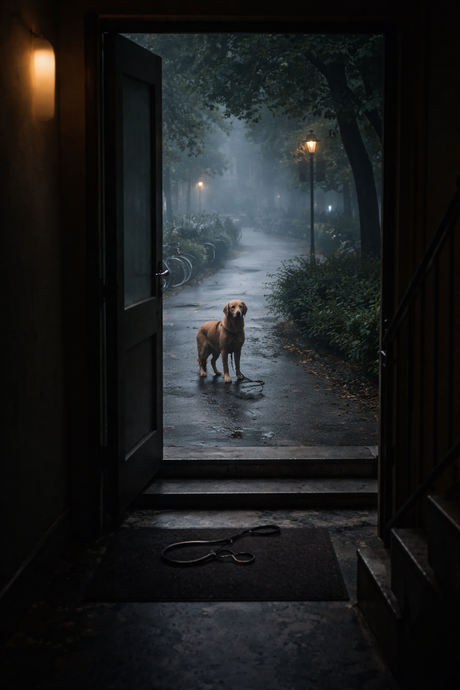
Meanwhile, Sebastian walked the same route every day. He wore a hat that was too thin for the cold, but he put it on anyway, as if it were a sign: I am who I have always been.
The dog walked beside him. A brown mongrel, nothing special—except that it was a creature that understood routine as truth. Sebastian didn’t speak to it much. He didn’t need to. The dog knew when it was time to move on.
Sebastian was one of those people you don’t describe, because description would give them too much weight. He wasn’t the man in the long coat. He wasn’t the one people later say, “You could tell.” He was the one they say of: “I would never have thought.”
And that, in novels as in life, is the sentence that lies the most.
Chapter 4 – The Crack in the Pattern
The clue did not come from the system.
It came from a stairwell.
Anouk had an appointment in another case, completely ordinary, and afterwards she spoke briefly to a colleague who was complaining about something else: too many files, too little time. In passing, the colleague mentioned, “We’ve got a witness note—tiny, probably nothing. A neighbour says someone was unusually out without their dog.”
Anouk stopped. Not because the sentence was spectacular, but because it didn’t fit the machine’s language.
“Without their dog?” she asked.
The colleague shrugged. “Yes. Apparently he always goes out with the dog. And that day… not. The dog barked. The neighbour heard it.”
Anouk took the slip of paper. A name, an address. No score.
Later she sat in her office and placed the paper next to the report. Two worlds. One high-gloss. The other handwritten.
Anouk thought: When truth is small, it is often overlooked.
She had the address passed on to her. She drove there—not with flashing lights, not with drama. Simply there, the way you go to a place that might be nothing. That might be everything.
The building was unremarkable. Not an old building, not a new one—one of those in-between forms Berlin has everywhere. A man was standing in front of the entrance, smoking. Anouk showed her ID. He didn’t look startled, just tired.
“What’s this about?” he asked.
“An observation,” Anouk said.
He nodded. “The dog.”
Anouk realised how much she hated that something so serious should hinge on a dog—and how much she needed it at the same time.
The stairwell smelled of animal. Not unpleasant. More like life. She heard scratching, then barking behind a door.
“He always takes him,” the man said. “Really. Every day. Same time. And that day… I was off sick. I saw it by chance. He left alone. Without the dog. The dog was howling like it had been forgotten.”
Anouk didn’t write anything down. She just listened. She wanted to know whether the sentence was real, or whether it merely felt good in retrospect. People like to remember things in a way that makes them important later.
But the man didn’t seem important. He seemed like someone who would rather be elsewhere.
“Why did you report it?” Anouk asked.
He looked at her. “Because it didn’t fit. And because everyone says you should say something when something doesn’t fit. So I said it.”
Anouk nodded. And thought: This is how it starts. Not with heroes. With people who don’t look away.

Chapter 5 – Aftermath
When Anouk called Mara, she didn’t say, “We have him.”
She only said, “I think I understand now why the score was so high.”
Mara was sitting at the table. She had written little in recent days. Not because she lacked words, but because every word felt like a risk.
“Why?” Mara asked.
“Because you are visible,” Anouk said. “Because you have language. Because you have networks. Because you exist in data.”
Mara was silent. Then: “And the other one?”
Anouk answered slowly. “The other one barely exists in data.”
Mara laughed once, briefly. “So in the end the one who is less human wins?”
“No,” Anouk said. “He doesn’t win. But he is overlooked longer.”
Mara closed her eyes. She saw again the sentence at the bus stop: We are not prepared. And thought: Perhaps we are not even prepared for the wrong questions.
Later Anouk met Sebastian. No dramatic scene. No heroic line. Sebastian sat in his flat, the dog beside him, and looked like someone who didn’t understand why the world was suddenly interested in him.
Anouk looked at him and felt something she rarely felt: not hatred, not triumph, but grief. Grief at how small a person can be—and how large their damage.
“Why?” she asked.
Sebastian shrugged, as if the question were too big. “Because otherwise no one does,” he said. “Because someone has to show them they’re not invulnerable.”
“You endangered people,” Anouk said.
Sebastian looked at her calmly. “That’s the system,” he said. “Not me.”
Anouk thought: That is the sentence that allows everything.
And she knew she had heard it a hundred times before, in other forms, in other offices, in other cases. People handing responsibility away because they don’t want to carry it.
Later, back at the office, Anouk wrote a note. Not about the act. About the method. About limits. About the score.
She wrote: The machine was right about everything it saw.
She paused, then added: It simply did not see everything.
Weeks later Mara received a short letter: proceedings against her discontinued. No apology. No sentence like We regret. Just bureaucracy pretending nothing had happened.
Mara sat down at her table. She opened a new document. She did not write about perpetrators. She wrote about seduction.
She wrote: AI is not God. And deleted it. Too big. Too declarative.
She wrote: A score is not a human being. And left it.
Then she wrote the first sentence of the text she had actually wanted to write:
I work with machines.
But I do not want them to judge in my place.
Outside, the city hummed again. The base note was back.
And yet it was not the same—as if one had once heard that it could be missing, and would never forget it again.
Kommentar schreiben